 Unique, "EB on Breast"
1787 Brasher Doubloon from
The Gold Rush Collection
|
"Barnacles of Gold" - The Story of Dahlonega's Famed Findley Mine
By Anne Dismukes Amerson
The Findley Gold Mine was one of Dahlonega’s most famous and
productive mines for almost a century. Opened shortly before the Civil War
and abandoned soon after the United States entered World War II,
the mine site was largely forgotten over the years except by history
buffs and gold mining enthusiasts.
Discovery of the Famed Findley Chute
The
earliest information about the Findley Chute (alternately spelled
“Shute” and “Shoot” and referring to a rich
vein) comes from a mining pamphlet published August 1, 1875, by
W. Reese Crisson, who owned the property at the time. In it, Crisson
states that “the celebrated Findley vein....was discovered
in 1858 by a man by the name of Duncan, who was employed by Col.
J. J. Findley to test for gold, and while thus employed found this
rich vein.”
Crisson
went on to explain that Findley had gone into partnership with local
entrepreneur Harrison W. Riley and the two of them had worked the
mine to a depth of 160 feet. At that point, they struck a vein of
water, which poured into their shaft and forced them out.
Crisson
also gave an eyewitness account of seeing Findley hand-mortar a
gallon bucket of ore taken from one of the mine’s pockets.
When he had removed the rock, a half-gallon of pure gold was
left.
An
interesting story about Duncan was related by W. R. Crisson’s
son, E. E. Crisson to Andrew W. Cain, who includes it in the section
on the Findley Chute in his
History of Lumpkin County
for the First Hundred Years 1832-1932
. According to
the story, Duncan claimed he was part Indian and said he could dream
where to find gold. It was supposedly in such a dream that he saw
an incredibly rich vein of solid gold and knew where to dig to find
it.
The Beginning of Vein Mining
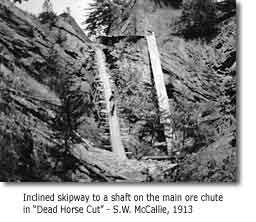 Prior
to Duncan’s discovery, vein mining was still relatively new
in the area. Gold had been discovered near the Chestatee River in
1828, but the miners who flocked to north Georgia hoping to strike
it rich panned the streambeds using placer mining tools and
techniques,
including pans, sluice boxes, and rockers. They did not initially
realize that the loose particles of gold did not originate in the
streams but had washed down from the hills by the forces of erosion.
It was not until the “easy gold” had been found that
men turned their sights and their shovels into the hillsides in
their quest for the precious metal.
Prior
to Duncan’s discovery, vein mining was still relatively new
in the area. Gold had been discovered near the Chestatee River in
1828, but the miners who flocked to north Georgia hoping to strike
it rich panned the streambeds using placer mining tools and
techniques,
including pans, sluice boxes, and rockers. They did not initially
realize that the loose particles of gold did not originate in the
streams but had washed down from the hills by the forces of erosion.
It was not until the “easy gold” had been found that
men turned their sights and their shovels into the hillsides in
their quest for the precious metal.
Ownership of the Findley Property
The
history of ownership of Land Lot 1,048, on which almost all the
Findley mining operations took place, is complex, for it was divided
into half- and quarter-lots, all of which changed hands more often
than pieces of property on a Monopoly game board. Disagreements
about ownership followed by law suits were common. Information about
the numerous owners is available, but this article will focus only
on those who made significant developments to the property.
The
lot was originally granted by the State to Talbot Davison, of Jones
County, in the Cherokee land lottery of 1833. Although there were
several owners in the years between 1833 and 1852, apparently the
first person to make any use of the land was Charles M. McJunkin,
a woodcutter. After having cut the timber on the property, he sold
his half of the lot to James Jefferson Findley in February of 1858.
At that time the lot was considered an “old horse” that
had seen better days.
Soon
after the purchase, Findley secured the services of Charles Duncan,
who was reputed to be one of the best prospectors in the area to
prospect his newly acquired lot for gold. As described above by
W. R. Crisson, Duncan soon found a small but remarkably rich vein
which has become famous in the annals of Lumpkin County gold mining
history as “The Findley Chute.”
Findley
and his partner, Harrison W. Riley, worked the chute for three or
four months and excavated a 4 by 6 foot incline shaft
“sufficiently
large to permit three men to work at the same time.” The rich
yields from the mine were reportedly carried to the Dahlonega Mint
in a bucket after dark to avoid attracting attention. Findley’s
and Riley’s operations came to an abrupt halt when water filled
the shaft to a depth of 8-10 feet.
Attempts to Recover the Lost Chute
Subsequently,
the Findley property was sold to the Stephenson Gold Mining Company
in 1863. Dr. M. F. Stephenson (assayer at the Dahlonega Branch Mint
1850-1853) sunk a 100-foot shaft at the top of the hill north of
the chute. He then cut a tunnel from the bottom of the new shaft
that was designed to strike the chute from that angle. His operations
were halted by the scarcity of labor and the high price of powder
for blasting the rock. Later operations proved that his tunnel stopped
only five or six feet from the chute.
The Dahlonega Mining Company purchased the Findley property in 1866
but did little work on the mine aside from running a long tunnel
designed, like Singleton’s, to strike the chute at the bottom
of the incline (a distance of about 500 feet). After driving 300
feet, Superintendent Amory Dexter halted work after workers hit
a belt of very hard rock. His decision was also influenced by a
title dispute.
In 1868, the Dahlonega Mining Company leased the Findley and Lockhart
mines to local miners Crisson and Huff. In 1871, W. R. Crisson (Huff
having retired by this time) moved the Lockhart’s 24-stamp
mill to the Findley and began mining operations on that property
after replacing the badly worn stamps with new ones.
In 1875, N. H. Hand (General Manager for the Dahlonega Mining Company)
began to develop the property in order to place it on the market.
Frank W. Hall was put in charge of the work. He drove a tunnel from
the Dexter tunnel to the bottom of the Stephenson shaft and successfully
continued the Stephenson tunnel to the elusive chute. Hall reported
taking out “about $3,000 in handsome free gold specimens and
that a great deal more was left in place, the object of the work
being to develop the mine for sale.”
It
was during this time that “the Little Findley Mill”
was erected on the northwest side of the ridge to mill the ore brought
by flume from the large cut on top of the ridge started by W. R.
Crisson. This mill was the 10-stamp Hall mill moved from the Lawrence
Mine (located on the Mustering Ground near the Dahlonega Public
Square) and was run by steam.
Findley Ridge, Backbone of the Georgia Gold Belt
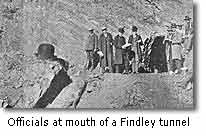
In
1878, the Findley Gold Mining Company of New York City purchased
the property for $30,000. According to a prospectus published by
the company that year, the Findley lot “is conceded by every
one to contain the largest mass of gold-bearing ores in the Southern
belt.” Findley Ridge, called the “backbone” of
the Georgia gold belt by mining engineers and geologists, was dramatically
described as “a precipitous ridge, jutting into the valley,
with almost sheer ascent of 500 feet above the level of the river.”
The celebrated Findley Vein was described in the prospectus as “a
clear, lively quartz lode about three feet thick, carrying a remarkably
rich ‘pay streak’ of two to eight inches, and yielding
in many places almost pure masses of gold.” It went on to
note that “nuggets weighing from twenty to fifty pennyweights,
are sometimes broken from the quartz while taking down the vein”and
“one mass of quartz and gold taken from this lode, weighing
about twelve pounds, produced nearly eight pounds of gold.”
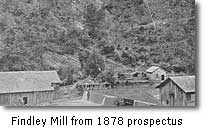 The
Findley Gold Mining Company enlarged the “Little Findley Mill”
to 20 stamps and increased its steam power. It also replaced the
24-stamp mill beside Yahoola Creek with 40 stamps and installed
steam pumps to raise water from the Findley Ditch 175 feet to the
top of the ridge for use in working the upper cut.
The
Findley Gold Mining Company enlarged the “Little Findley Mill”
to 20 stamps and increased its steam power. It also replaced the
24-stamp mill beside Yahoola Creek with 40 stamps and installed
steam pumps to raise water from the Findley Ditch 175 feet to the
top of the ridge for use in working the upper cut.
This
information is confirmed by an item in the September 8, 1876, issue
of Dahlonega’s newspaper, The Mountain Signal: “A ram
of the largest size is throwing water into a reservoir on the summit
of the hill 153 feet above the ditch....”
The Dahlonega Method
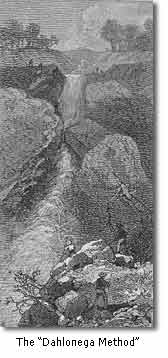 A
reservoir was dug at the top of the ridge to store the water, which
was released at the end of the day to wash the ore from the cuts
down to the mill. This method was apparently developed locally and
came to be known as “the Dahlonega Method.”
A
reservoir was dug at the top of the ridge to store the water, which
was released at the end of the day to wash the ore from the cuts
down to the mill. This method was apparently developed locally and
came to be known as “the Dahlonega Method.”
That
process was colorfully described by a writer sent to Dahlonega in
1879 by
Harper’s New Monthly Magazine
to research and write an article on “Gold Mining in Georgia.”
The article which appeared in the September 1879 issue provides
wonderful eyewitness descriptions of scenes long vanished in time,
such as “the ruins of the old United States Mint, looking
very romantic in the sunset glow.” Many of them are illustrated
with fine pen-and-ink drawings, including a dramatic scene showing
great torrents of water sweeping ore down the hillside to be processed
in the mill below.
“This
operation is called ‘flooding’ the mine, and one evening
we rode out to the Findley Mine to see it,” wrote the unnamed
author. “There the cut runs straight up and down the side
of a hill 500 feet high, and is in the form of a deep, irregular,
vertical trench.....We climbed to the summit of a high knoll jutting
up by the line of the cut, and waited. In a moment an ominous ‘grumble
and rumble and roar’ was heard, which, beginning faint and
far aloft, gradually grew more threatening, until there was a sudden
volley of sound, and at the end of the narrow trench a mighty mass
of red-brown waters came leaping over the ledge....But it was not
all water, nor even mud. Tons upon tons of broken rocks were coming
down through this terrible flume, rolling over and over, rattling
among their fellows, grinding along the walls, bounding out of the
narrow crevice, leaping high above the red spray, and falling in
ringing rain upon the stony floor. The noise was a hoarse, crushing,
terrific roar. The force was prodigious.”
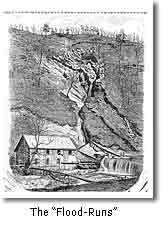 The dimensions of the reservoir on Findley Ridge were given by State Geologist W. S. Yeates in his
Preliminary Report on a part of the Gold Deposits of Georgia
published in
1896. It was “150 feet long, 15 feet wide, and 6 feet deep,
from which water is delivered, by ditches and iron pipes, to various
parts of the open cuts, for making the flood-runs of saprolite from
the cuts to the mill, and for operating the hydraulic giants.”
The dimensions of the reservoir on Findley Ridge were given by State Geologist W. S. Yeates in his
Preliminary Report on a part of the Gold Deposits of Georgia
published in
1896. It was “150 feet long, 15 feet wide, and 6 feet deep,
from which water is delivered, by ditches and iron pipes, to various
parts of the open cuts, for making the flood-runs of saprolite from
the cuts to the mill, and for operating the hydraulic giants.”
Despite
the glowing description of the Findley property and its potential
described in its prospectus, the Findley Gold Mining Company apparently
did not prosper. According to Yeates, this company made the error
of sending a young relative of a stockholder, fresh out of mining
school, to be superintendent of the mine. He was unwilling to take
suggestions from experienced local miners and was unable to find
the famed chute, which had been lost. After some work in the open
cuts, the operation came to a halt after a couple of years.
The Findley Chute: Lost - Found - Lost Again
In
1880, R. B. King leased the property. He located the Findley Chute
almost immediately and mined it with great success. Just before
his year’s lease expired, he “lost” the Chute
intentionally! He reportedly made enough from the vein in twelve
months to start a bank in Denver, Colorado.
The
Findley Gold Mining Company continued to own but not work the Findley
property until it was sold at sheriff’s sale in 1885. In 1890,
it was purchased by the Trefoil Gold Mining Company of St. Louis,
Missouri. This company repaired the mill and put in a set of concentrators,
which proved a fruitless expense.
At
the time of State Geologist Yeates’ visit to the Findley Mine
in 1895, the property was owned by Christian Wahl, of Milwaukee,
Wisconsin, and managed by Capt. H. D. Ingersoll. Yeates noted that
“while no extensive work seems to have been done, yet the
work on it has been constant;.....and the property is one of the
best developed in the county.”
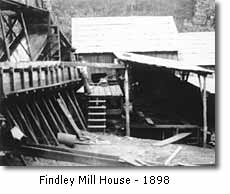 Yeates
described the mill house as containing 40 stamps, each weighing
450 pounds, 20 of which were “practically new.” “When
last rebuilt,” Yeates wrote, “the mill-house was planned,
so as to admit of the introduction of a concentrating plant, for
handling the sulphide ores.”
Yeates
described the mill house as containing 40 stamps, each weighing
450 pounds, 20 of which were “practically new.” “When
last rebuilt,” Yeates wrote, “the mill-house was planned,
so as to admit of the introduction of a concentrating plant, for
handling the sulphide ores.”
The
mill was driven by water contained behind a 17-foot-high dam across
Yahoola Creek. A 32-inch Leffel turbine wheel furnished 60 H. P.
The large pump in the pump house had been installed in 1895 by the
current owner of the property, C. Wahl, and was used to pump water
to the reservoir on top of the ridge. The water was taken from the
Findley ditch, which ran about halfway up the ridge.
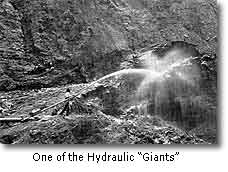 Note: This
was one of numerous adueducts which conveyed water
from higher elevations with enough pressure to operate
hydraulic cannons. What was a slow and laborious
process for a man with a pick and shovel was
accomplished in a mere fraction of the time by a great
jet of water tearing away the earth with as much
pressure as 135 lbs. per square inch. It was common
to estimate the work of a water cannon as equal to the
labor of ten men.
Note: This
was one of numerous adueducts which conveyed water
from higher elevations with enough pressure to operate
hydraulic cannons. What was a slow and laborious
process for a man with a pick and shovel was
accomplished in a mere fraction of the time by a great
jet of water tearing away the earth with as much
pressure as 135 lbs. per square inch. It was common
to estimate the work of a water cannon as equal to the
labor of ten men.
A booklet
entitled, "Announcement of the Dahlonega Consolidated Gold
Mining Company" of Dahlonega, Georgia, published in 1899, described
the Findley Mine and Mill as “unquestionably one of the most
desirable properties in the South.” It went on to say, “The
high, steep hill, rising abruptly above the mill, has always been
considered as the heart of the Georgia gold belt. On the hill is
situated the celebrated “Findley Shute,’ a wonderfully
prolific pocket vein from which alone at least $2000,000.00 have
been taken out and which does not appear to be exhausted.”
The
booklet continued with a glowing detailed description of the property,
noting the “40-stamp mill in excellent repair, and another
piece of machinery which is a novelty....a pump....which is the
only machine of its kind in existence, a Duplex water motor, made
by Filer & Stowell, of Milwaukee. It operates, from the canal
water, under a head of 283 feet and lifts 176,000 cubic feet of
water to the vertical height of 435 feet daily.”
“Barnacles of Gold”
An article appeared in the April 27, 1901,
Atlanta Journal
Dahlonega, the Center
of Yellow Metal Enterprises” and “Excitement Over the
Rediscovery of a Long Lost Mine.”
After
describing how the “dull, sleepy town of four years ago”
had been transformed into a “busy, bustling little city”
as a result of the magnitude of the developments (including electric
lights) made by the Consolidated Mining Company, McNelley told of
“the latest and by far the richest discovery ever made in
the mines here.” He went on to relate the history of the Findley
Chute and tell how “two practical miners of this place”
named Witt & Campbell had set out with determination to locate
the “long-lost treasure.”
Campbell
got discouraged and quit, and Witt was almost at the point of giving
it up as a fruitless search when he instructed his workmen to put
in “one more shot.” If that didn’t break into
the gold, they were to “pull out their tools and give it up
as a bad job.” The hole was drilled, the dynamite put in,
the fuse ignited, and the men hurried out of the hole. After the
explosion when the smoke had cleared, the miners went back inside
“with bated breath to discover the result.” There, to
their astonishment, they saw “exposed to the naked eye an
almost solid mass of gold nuggets sticking out like warts on the
face of the quartz.” They had struck the famed Findley Chute!
According
to McNelley, the discovery had taken place “about two weeks
ago.” “Captain” Witt had kept his men constantly
working to extract the ore and had already mined 326 pounds of the
rich ore. He was obviously eager to get as much gold as possible
before his lease expired on June 1, at which time the property would
be taken over by the Consolidated Company.
The
Journal
correspondent described the “chute
or ore in the mine as zig-zag in shape” with”cones”
projecting right and left, each weighted down with “barnacles
of pure gold.” He wrote enthusiastically, “The seams
in the rock are full of nuggets and in many cases the quartz is
held together with pure gold.” He quoted an old miner as saying,
“The Findley is a-goin’ to run to Chiney, and the deeper
you git on the vein, the better and richer it will be.”
According
to McNelly, the Chute was excavated to “about 350 feet”
at the time. He noted that Consolidated Company planned to “drive
a tunnel in at the base of the hill and intersect the chute some
hundred feet below” in order to work the entire vein.
 The
Consolidated Company also proposed to increase the number of stamps
on the Findley property from 40 to 100 to give it a 200-ton capacity.
At an estimated average value of $3 per ton of ore, the expanded
Findley was expected to earn $600 per day. However, the company’s
grandiose dreams never came to fruition, and it was bankrupt by
1906. Some mining probably took place on the property in subsequent
years but on a minor scale.
The
Consolidated Company also proposed to increase the number of stamps
on the Findley property from 40 to 100 to give it a 200-ton capacity.
At an estimated average value of $3 per ton of ore, the expanded
Findley was expected to earn $600 per day. However, the company’s
grandiose dreams never came to fruition, and it was bankrupt by
1906. Some mining probably took place on the property in subsequent
years but on a minor scale.
Mining at the Findley in the 1920s and 30s
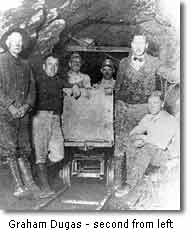 Major
Graham Dugas is usually associated with the Calhoun Mine, where
he made a big strike in the 1940s and made national news. However,
two old photographs show him with miners at the Findley Mine in
the late 1920s. The extent of his involvement there is not known.
Major
Graham Dugas is usually associated with the Calhoun Mine, where
he made a big strike in the 1940s and made national news. However,
two old photographs show him with miners at the Findley Mine in
the late 1920s. The extent of his involvement there is not known.
A decade
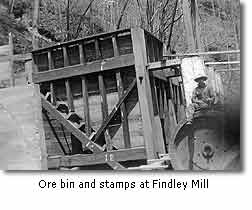
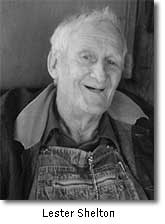
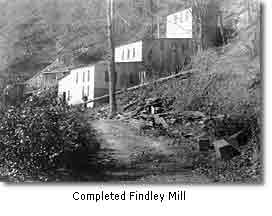
later, Cornelius O’Kane erected a new mill on the Findley
property beside Yahoola Creek. Lester Shelton worked for O’Kane
at the time and helped clear out the area around the old mine so
the new stamp mill could be built. He hauled sand from a sandbar
on the other side of Yahoola Creek to put in the cement of the foundation.
 “There
wasn’t much of a road to the Findley at that time, so I helped
work on it with a drag-pan and mule,” he related to this author
in a 1993 interview. “It was real narrow because there wasn’t
much room between Yahoola Creek and the bluffs of Crown Mountain.
When the owners bought a diesel engine to run the mill, nobody thought
they could get it in on that road except for Tal Odum, who said
he would do it.
“There
wasn’t much of a road to the Findley at that time, so I helped
work on it with a drag-pan and mule,” he related to this author
in a 1993 interview. “It was real narrow because there wasn’t
much room between Yahoola Creek and the bluffs of Crown Mountain.
When the owners bought a diesel engine to run the mill, nobody thought
they could get it in on that road except for Tal Odum, who said
he would do it.
“Tal
was behind the wheel, and I was standing in the back of his old
Chevrolet truck holding on to the engine to keep it from shifting,
when the vehicle started to tilt sideways. The weight of the engine
was making the tires on one side sink deep into the soft dirt. I
jumped off just as the truck started to turn over. I yelled at Tal,
but he was already jumping free. We watched helplessly as the truck
turned bottom-side up in the middle of the Yahoola!”
Paul
Early helped move the 10-stamp “Little Findley” mill
from up on Findley Ridge down to the new mill. Other heavy equipment
was moved to the Findley from the Mary Henry gold mine. According
to Early, a tunnel was dug into the base of Findley Ridge with the
intention of striking the historic Findley Chute, but the ore dug
out of the tunnel proved to be of a disappointingly low grade.
Playing “Goldball”
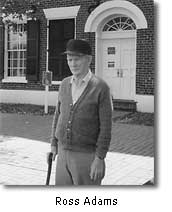 Ross
Adams also worked at the Lockhart and Findley Mines when they were
owned by “Ol’ Man O’Kane.” “My job
was usually shoveling ore with a square-bottomed shovel to feed
the stamps that pounded it into fine dust, but the Findley was a
self-feeder with a hopper that fed ore directly to the stamp mill,”
he related in a 1993 interview with this author. “The crushed
ore went into a sluice box to be washed. The gold was heavier and
fell to the bottom, where it was caught on copper plates coated
with quicksilver.
Ross
Adams also worked at the Lockhart and Findley Mines when they were
owned by “Ol’ Man O’Kane.” “My job
was usually shoveling ore with a square-bottomed shovel to feed
the stamps that pounded it into fine dust, but the Findley was a
self-feeder with a hopper that fed ore directly to the stamp mill,”
he related in a 1993 interview with this author. “The crushed
ore went into a sluice box to be washed. The gold was heavier and
fell to the bottom, where it was caught on copper plates coated
with quicksilver.
“Every
week or so we would have what was called a ‘cleanup’
to get the gold. First, the mercury plates were scraped with a piece
of hard rubber. Then the mass of gold and quicksilver was put into
a round iron container and heated in the blacksmith’s forge.
The heat made the quicksilver boil out and caused the gold to melt
and run together so that it came out looking like a half a pound
of yellow butter. Sometimes it would weigh six or seven pounds,
and I remember throwing a good-sized ball of gold back and forth
with another fellow like we were pitching a baseball.
“I
also drilled with a jackhammer inside the mines and set off dynamite
to blast out the rock. There was always a bell set up on the hill
that was rung to let everybody know there was dynamite in the hole
fixin’ to blow. One time I just barely got out in time, and
the blast liked to have knocked me down!”
O’Kane’s
new Findley Mill began operations in the summer of 1940 but only
operated a couple of years before World War II put a halt to mining.
Men were drafted, and dynamite was unavailable. A college student
named Hinton Amerson exploring the mill in 1953 found a newspaper
dated 1942, suggesting that the mine was still operating at that
time.
Col. James Jefferson Findley
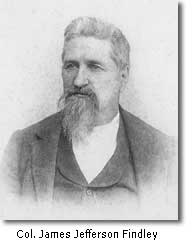 No
history of the Findley Mine would be complete without some information
about the man whose name has come down in history because of its
association with the mining property and the knob of Crown Mountain
still known today as “Findley Ridge.” Since Findley
didn’t purchase the property until 1858, the ridge may not
have had a name when Dr. Matthew F. Stephenson made his famous speech
from the porch of the Lumpkin County Courthouse attempting to dissuade
local miners from leaving to join the 1849 California Gold Rush.
No
history of the Findley Mine would be complete without some information
about the man whose name has come down in history because of its
association with the mining property and the knob of Crown Mountain
still known today as “Findley Ridge.” Since Findley
didn’t purchase the property until 1858, the ridge may not
have had a name when Dr. Matthew F. Stephenson made his famous speech
from the porch of the Lumpkin County Courthouse attempting to dissuade
local miners from leaving to join the 1849 California Gold Rush.
“Why
go to California?” he asked them, pointing dramatically toward
the small mountain about a half-mile south of the Dahlonega Public
Square. “In that ridge lies more gold than man ever dreamt
of. There’s millions in it!” The miners who disregarded
his words and headed West nevertheless quoted the expression until
"There's millions in it" became a popular idiom. Mark
Twain further immortalized the phrase by using it in his book, "The
Gilded Age."
James
Jefferson Findley was born in 1829 and reportedly came to Dahlonega
at a young age. A lawyer by profession, he was elected sheriff of
Lumpkin County and later represented the county in the Georgia Legislature.
During
the Civil War, Findley was a Major in Company D, 52nd Georgia Regiment,
C.S.A. (“Boyd Guards”) and afterwards a Colonel who
commanded the Lumpkin County Home Guards. He had his headquarters
in the 1836 courthouse, which also served as a jail for deserters,
bushwhackers, and other military prisoners. In October of 1864,
he was the officer in charge who ordered the execution of three
Union soldiers, whom he believed to be bushwhackers who had been
burning and looting in the area. A month later, Col. Findley and
his 1st Georgia State Cavalry Home Guards followed raiding Union
troops over the top of Amicalola Mountain and captured them after
a skirmish that took place in Bucktown in Gilmer County.
J.
J. Findley had three sons by his first wife, Elizabeth Stephens
(1825-1879). He married Martha Mathilda Williams (1848-1931) of
Dahlonega in 1886. Their only child, Jefferson William Findley,
was born in 1887, but Findley did not live to see this son grow
up. He died of cancer in 1888. In his obituary published in the
March 9, 1888
Dahlonega Signal
, he was
described as “true to principle, true to friends, a genial,
wholesome, liberal, gentleman” who always “wore a cheerful
smile.”
The Findley Ridge Roadside Park and Historical Marker
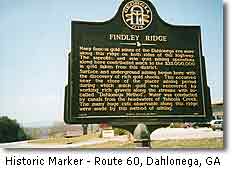 In
1961, a roadside park was created beside Highway 60 where it crosses
Findley Ridge on Crown Mountain. It was located in a hollowed-out
area created when top soil was dug out and hauled away for use as
a base for paving the road. According to Madeleine Anthony, who
wrote a feature article about the Findley Ridge Park for the
Gainesville
Times
, the top soil removed was gold ore, making Highway
60 “the only one anywhere with a gold base.”
In
1961, a roadside park was created beside Highway 60 where it crosses
Findley Ridge on Crown Mountain. It was located in a hollowed-out
area created when top soil was dug out and hauled away for use as
a base for paving the road. According to Madeleine Anthony, who
wrote a feature article about the Findley Ridge Park for the
Gainesville
Times
, the top soil removed was gold ore, making Highway
60 “the only one anywhere with a gold base.”
Anthony
related another piece of interesting information. “While hauling
off the gold-ore-top-soil,” she wrote, “workers uncovered
a gold vein only 10 feet from where a tunnel ended. Had the miner,
in 1850, continued his tunnel 10 feet more, he would have felt like
a millionaire overnight.”
For
some years visitors stopped at the roadside park to read the Findley
Ridge Historical Marker and enjoy the scenic view of the town below
with its backdrop of blue-green mountains. Local residents sometimes
took picnic lunches to eat on the concrete tables or had cookouts
on the outdoor grills. While Highway 60 was widened, however, the
small roadside park was destroyed. The Findley Ridge Historical
Marker put up by the Department of Natural Resources was missing
for a number of years but has now been replaced and may be seen
on the right side of the road as motorists reach the summit of Findley
Ridge headed into Dahlonega.
Attempts have been made in recent years to open the
historic site to those interested in viewing the
remaining artifacts, but the costs of making the area
safe and accessible were prohibitive. At this time
the Findley property is privately owned and is not
open to the public.
|